

Why operational maturity not busyness is what determines whether your business can scale
Most business owners know when their business feels heavy.
They feel it in the constant decisions.
The repeated questions.
The projects that slow down or balls that are dropped unless they step in.
The team that is busy, but not always moving in the same direction.
From the outside, the business may look successful. Revenue may be growing. Clients may be coming in. The team may be working hard.
But inside the business, everything still feels more dependent on the owner than it should.
That is usually the sign of an operational maturity gap.
Growth problems often get mislabeled as hiring problems, delegation problems, team problems, or time management problems. But underneath, they are usually stage problems.
The business has grown, but the operating structure has not grown with it.
That is where the Operations Ascension Ladder™ comes in.
The ladder gives you a way to understand where your business is today, what kind of support it actually needs, and why skipping stages often creates more frustration than progress.
Because not every business is ready for a Director of Operations.
And that is not a failure.
It simply means the business may need clarity, foundation, or leadership readiness first.
Why Operational Maturity Matters
A business does not become scalable simply because it is busy.
It becomes scalable when the work can move consistently without everything routing back to the owner.
That requires operational maturity.
Operational maturity means your business has the clarity, structure, systems, and leadership rhythm needed to support growth without adding more chaos.
Without it, growth often creates pressure instead of freedom.
More clients create more communication.
More projects create more decisions.
More team members create more coordination.
More opportunity creates more demand on the owner.
That is why growth can start to feel heavier instead of easier.
The issue is not always that the business needs more people.
Sometimes the business needs to understand what stage it is actually in.
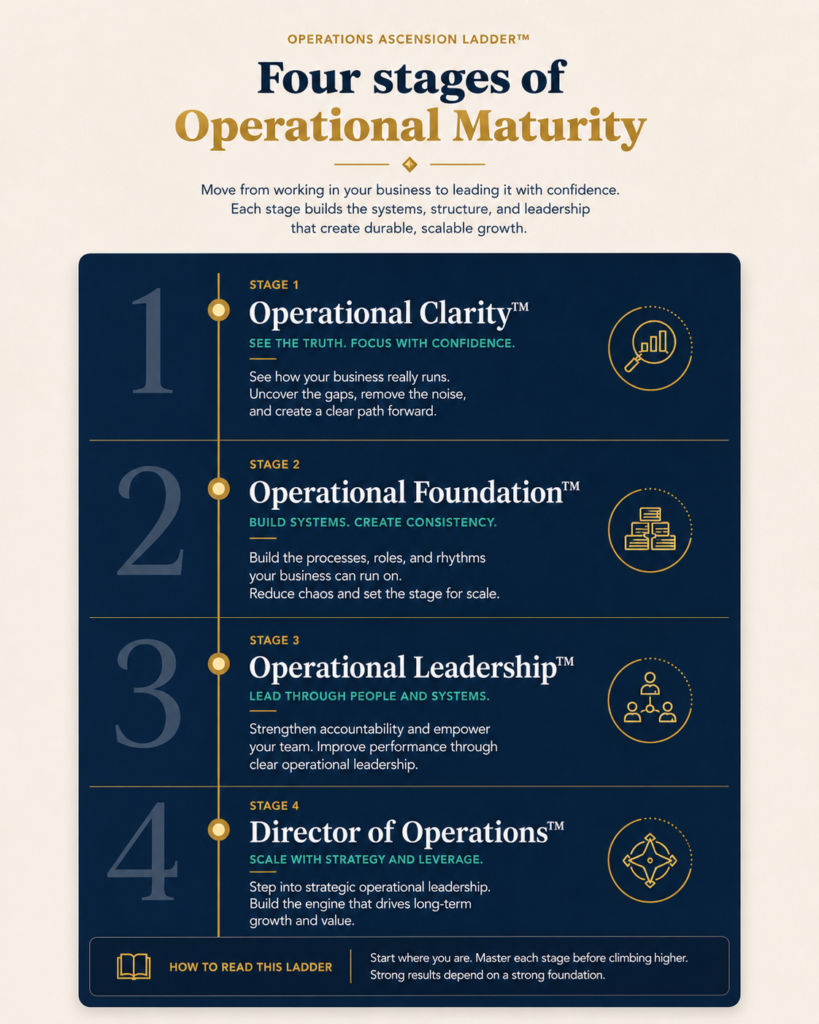
The Operations Ascension Ladder™
The Operations Ascension Ladder™ is a simple way to understand how businesses grow operationally.
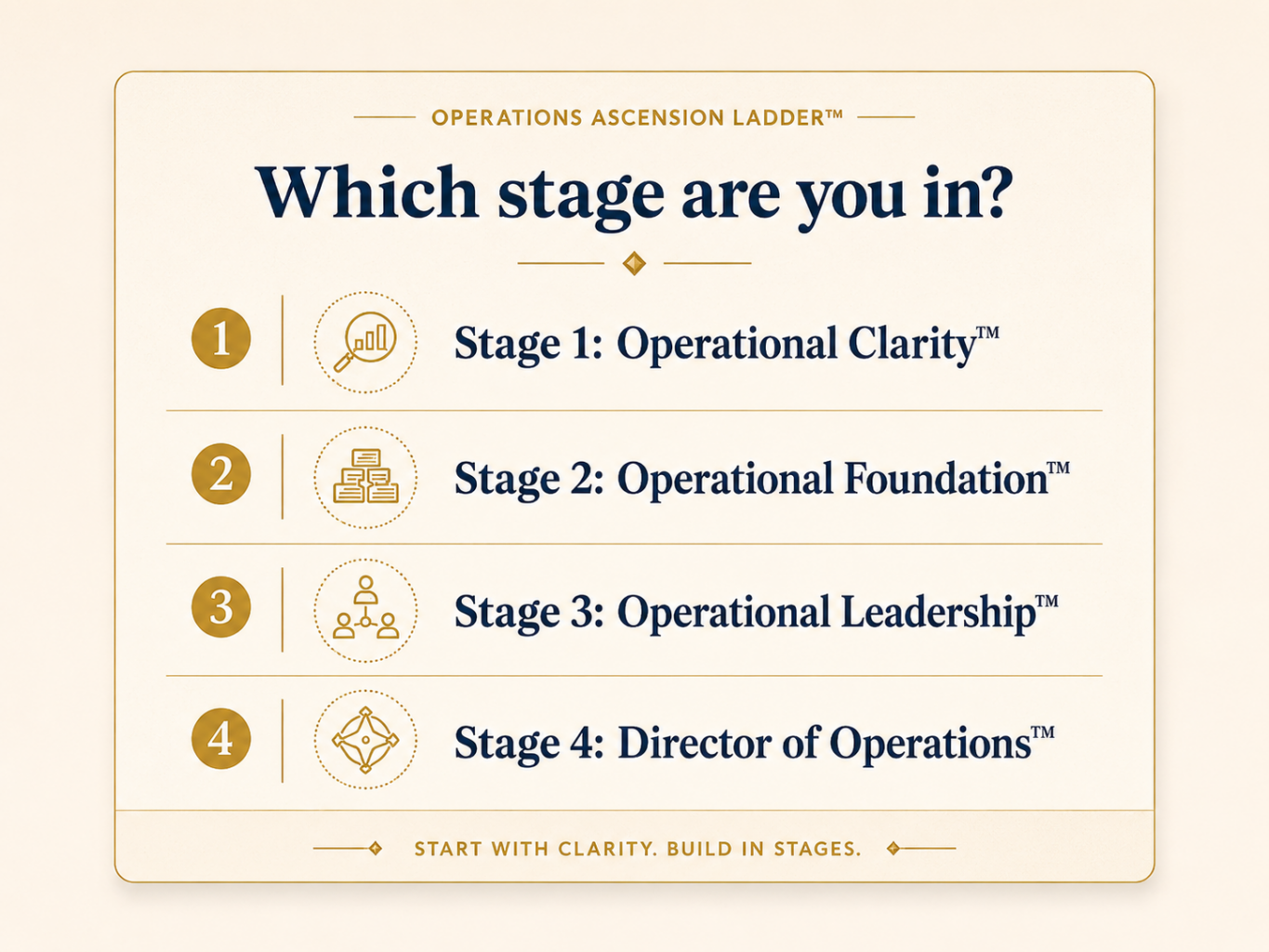
The stages are:
- Operational Clarity™
- Operational Foundation™
- Operational Leadership™
- Director of Operations™
Each stage serves a different purpose.
The mistake many growing businesses make is trying to jump ahead.
They hire more help before roles are clear.
They bring in leadership before workflows are defined.
They expect delegation to work before ownership exists.
They look for a Director of Operations before the business is ready to support one.
That is how operational frustration compounds.
A stronger path to growth is to move stage by stage.
Understand how the business actually runs
Stage 1 is where most growing businesses need to begin.
At this stage, the business is usually active, busy, and generating momentum, but the owner is still too central to daily execution.
You may be in Stage 1 if:
- Everything still runs through you
- Your team asks the same questions repeatedly
- Decisions keep coming back to you
- Workflows exist in people’s heads, not in writing
- You know something is off, but you cannot clearly name it
This is the stage where business owners often say:
“I need help.”
“I need better systems.”
“I need to delegate more.”
“I think I need someone to manage this.”
All of that may be true.
But before you decide what to build or who to hire, you need to understand what is actually happening.
Operational Clarity™ is about visibility.
It shows how work moves through the business, where decisions slow down, where ownership is unclear, and where the owner is still acting as the operating system.
The goal of Stage 1 is not to fix everything at once.
The goal is to stop guessing.
Because once you can see where things are not running smoothly, you can make better decisions about what needs to happen next.
Stage 2: Operational Foundation™
Build systems that make execution repeatable
Once the business has clarity, the next stage is foundation.
Stage 2 is where structure replaces scramble.
This is where workflows, roles, responsibilities, and operating rhythms become more clearly defined.
You may be in Stage 2 if:
- You know where the friction is, but systems are still inconsistent
- Delegation works sometimes, but not reliably
- Team members are capable, but ownership is not clear
- Work gets done, but not always the same way twice
- The owner is still too involved in checking, correcting, or approving
At this stage, the business does not need more theory.
It needs usable structure.
Operational Foundation™ may include:
- Documented workflows
- Clear roles and responsibilities
- Defined decision authority
- Repeatable client delivery processes
- Weekly operating rhythms
- Accountability structures
This is where a business starts to become less dependent on memory, urgency, and founder involvement.
It is also where many businesses begin to feel immediate relief.
Not because the work disappears.
But because the work finally has a place to go.
When foundation is strong, team members know what they own. Decisions move faster. Rework decreases. The owner can begin to step out of the middle.
This is the stage where the execution fo work in a business starts to become scalable.
Stage 3: Operational Leadership™
Strengthen accountability and reduce owner dependency
Stage 3 begins when the business has some structure in place, but the owner is still carrying too much leadership responsibility.
At this stage, workflows may exist. Roles may be clearer. The team may know more of what they own.
But the business still needs more oversight, accountability, and operational rhythm.
You may be in Stage 3 if:
- Your team can execute, but still needs more direction
- You have systems, but they are not always followed consistently
- You are still the person making sure everything stays on track
- Managers or team leads need support in owning outcomes
- The business needs operational oversight, not just task support
This is where operational leadership becomes more relevant.
But it still may not mean the business is ready for a full Director of Operations.
Operational Leadership™ is the readiness phase.
It strengthens the business so leadership can actually work.
At this stage, the focus may include:
- Accountability processes
- Team lead support
- Operational scorecards or metrics
- Decision-making guidelines
- Cross-functional communication
- Reduced founder involvement in daily execution
This stage matters because leadership without foundation becomes firefighting.
If a business does not have enough clarity and structure, an operational leader spends most of their time chasing information, clarifying ownership, and solving preventable problems.
That is expensive.
And often frustrating for everyone involved.
Stage 3 prepares the business for deeper operational ownership.
Stage 4: Director of Operations™
Introduce operational leadership when the business is ready
Stage 4 is where the business is ready for true operational ownership beyond the founder.
This is the stage many business owners want to jump to.
They want someone to “own operations.”
They want a second-in-command.
They want someone to manage the moving parts and turn their vision into execution.
That can be powerful.
But only if the business is ready.
You may be approaching Stage 4 if:
- The business has clear workflows and operating rhythms
- Roles and ownership are defined
- The team can execute without constant founder involvement
- The founder needs to focus more on vision, growth, partnerships, or exit strategy
- The business needs strategic operational oversight, not basic structure-building
A Director of Operations can be transformational when the foundation exists.
But a DOO is not a shortcut.
A Director of Operations is not there to magically untangle a business that has never defined how work flows, who owns what, or where decisions should happen.
That is why I often say:
A Director of Operations is not a solution. It is a milestone.
It works best when the business has earned that level of operational leadership.
Why Skipping Stages Creates Problems
Most operational problems get worse when businesses try to skip steps.
If you hire more help before clarifying roles, the new person inherits a mess.
If you delegate before defining ownership, every decision comes back to you.
If you add tools before mapping workflows, you create more places for chaos to live.
If you hire leadership before building foundation, that leader becomes a very expensive firefighter.
This is why “more” is not always the answer.
More people.
More tools.
More meetings.
More urgency.
None of those fix a lack of operational maturity.
They often expose it.
The better question is not:
“What do we need to add?”
The better question is:
“What stage are we actually in?”
Because the right next step depends on the stage.
How to Know Which Stage Your Business Is In
Here are a few questions that will help you begin to recognize where your business may be operating today. Keep in mind though that the real value comes from understanding not just which stage you’re in, but what is causing the problems in your business and what needs to happen next.
If you answer “yes” to these, you may be in Stage 1: Operational Clarity™
- Do decisions regularly come back to you?
- Do you know work is breaking down, but not exactly where?
- Are workflows informal or undocumented?
- Does the team ask the same questions repeatedly?
- Do you feel like the business still depends on you to function?
If yes, start with clarity.
You need visibility before you build.
If you answer “yes” to these, you may be in Stage 2: Operational Foundation™
- Do you know what needs to improve, but systems are not yet consistent?
- Are roles clearer than before, but still not fully defined?
- Does delegation work in some areas but fail in others?
- Do workflows need to be documented, simplified, or standardized?
- Does execution still depend too much on memory or urgency?
If yes, build the foundation.
You need repeatable structure before leadership can scale.
If you answer “yes” to these, you may be in Stage 3: Operational Leadership™
- Do you have systems, but need stronger accountability?
- Are team leads or managers struggling to fully own outcomes?
- Are you still the person making sure everything keeps moving?
- Do you need better operational rhythm, metrics, or oversight?
- Is the business beginning to outgrow informal leadership?
If yes, strengthen leadership readiness.
You need accountability and oversight before stepping into true operational ownership.
If you answer “yes” to these, you may be approaching Stage 4: Director of Operations™
- Are workflows, roles, and ownership already clearly defined?
- Can the business operate without your daily involvement?
- Do you need someone to lead operations strategically?
- Are you ready to step more fully into vision, growth, or transition planning?
- Is the business mature enough to support a true operational leader?
If yes, a Director of Operations may be the right next step.
But if not, that does not mean you are behind.
It means there is a stage to strengthen first.
The Real Goal: A Business That Runs Without You at the Center
The goal of operational maturity is not to make the business rigid.
It is not to create unnecessary management.
It is not to remove the founder’s influence.
The goal is to build a business that can operate with clarity, consistency, and confidence – without depending on the owner for every decision.
That is what makes growth feel lighter.
That is what allows teams to lead.
That is what makes delegation work.
That is what makes future operational leadership possible.
And that is what creates a business that is not just busy.
It is scalable.
Where to Start
If your business feels busy but fragile, do not rush to the next hire, tool, or title.
Start by identifying your stage.
Because the right next move depends on where your business actually is today.
If everything still runs through you, start with Operational Clarity™.
If work is inconsistent, build your Operational Foundation™.
If systems exist but accountability is still weak, strengthen Operational Leadership™.
And when the business is ready, a Director of Operations™ becomes the natural next step.
Not forced.
Not premature.
Earned.
That is the purpose of the Operations Ascension Ladder™.
It helps you stop guessing what your business needs and start building the structure that supports sustainable growth.
Because scalable businesses are not built by accident.
They are built in stages.