
I’m paying for help and still doing everything myself. If that sounds familiar, you may have hired the wrong kind of support or haven’t clearly defined what you need them to own.
A VA executes what you assign. An online business manager manages how the work gets done across projects and people. A Director of Operations, sometimes called a DOO, owns how the whole business runs and carries real accountability for it.
What Separates These Three Operations Roles?
The clean line between a VA vs. online business manager vs. Director of Operations is ownership: a VA owns tasks, an OBM owns projects and the team doing them, and a DOO owns the operating model itself. Think of a client onboarding workflow. Someone sends the welcome email and sets up the folder, someone makes sure onboarding happens on time across every client, and someone decides what onboarding should look like at all.
What Does a Virtual Assistant Handle?
A virtual assistant handles defined, repeatable work you hand over: email management, scheduling, data entry, social media scheduling, research, and basic customer service or client communication.
The strength here is execution. You say what needs doing, and it gets done without you touching it.
Where business owners get frustrated is when they expect a VA to set priorities or fix a messy process. That’s outside the role. If your task list changes daily and nothing is written down, a VA will keep coming back to you with questions.
A good sign you need a VA: you know exactly what to delegate, you just don’t have time to do it.
What Does an Online Business Manager Own?
An online business manager owns the day-to-day running of your business operations so work stops routing through you. That covers project management, team management, accountability for deadlines, and building or maintaining SOPs and operational systems.
Picture a launch. A VA schedules the emails. An OBM builds the launch timeline, assigns the pieces, chases the copywriter who’s behind, and tells you the webinar date needs to move.
OBMs manage the systems they’re given. If your business has no clear priorities, no defined roles, and no documented process, an OBM spends the first months building that foundation before the “management” part can work.
You know you’re ready to hire an OBM when you have a small team, multiple projects running at once, and you’ve become the obstruction between all of them.
What Does a Director of Operations Lead?
A Director of Operations or a fractional DOO oversees day-to-day operations and leads operational teams at the business level, shaping how the company delivers, hires, measures results, and scales. A fractional DOO is often a better fit for many businesses as the role provides part-time operational leadership.
A DOO looks at your client delivery and asks whether the model itself works. Are margins healthy? Is the team structured right? Should you keep this service line? Then they change it.
This is operational support with teeth. You’re not handing over a project, you’re handing over the question of how the business operates and trusting someone to answer it.
Signal you’re ready: you have documented systems, a team of several people, and you keep getting pulled out of strategic planning to fix delivery problems.
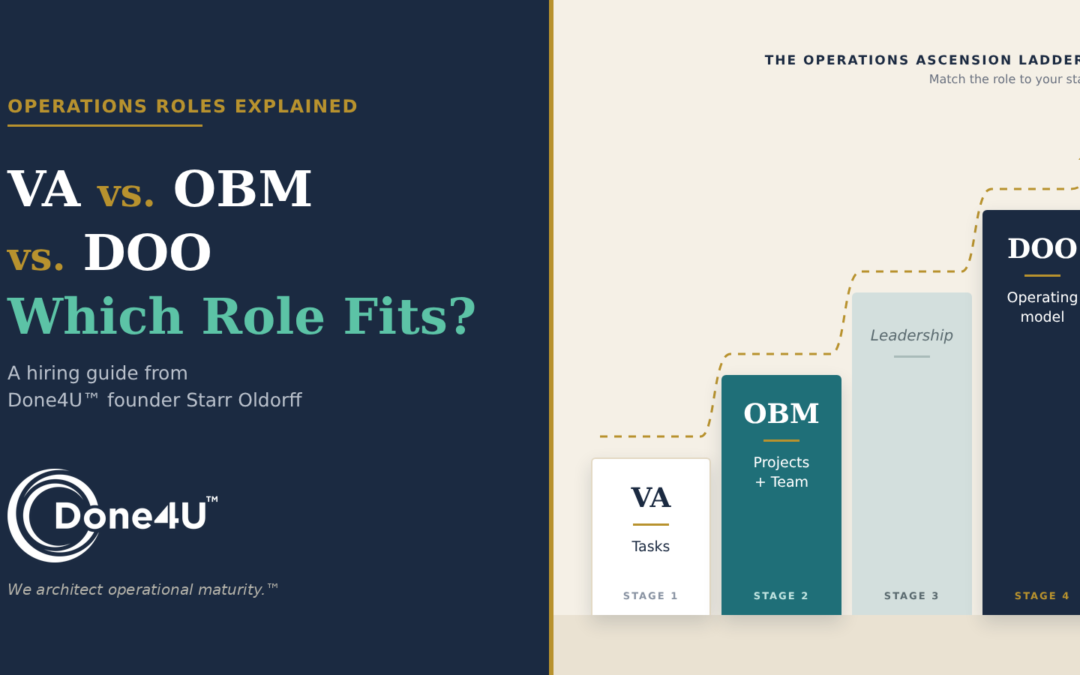
Match the Role to the Stage Using the Ascension Ladder
A tool such as the Operations Ascension Ladder™ helps you better understand which stage your business is in and where it stands operationally.
A Virtual Assistant (VA) most often fits Stage 1, when a founder needs help with defined, repeatable tasks such as inbox management, scheduling, data entry, or customer support. The founder still sets priorities and provides instructions; the VA carries out the work.
As the business develops clear processes and the VA begins coordinating workflows or improving how work gets done, the role may grow toward Stage 2.
An Online Business Manager (OBM) who’s building the operational foundation fits Stage 2: roles, workflows, handoffs, and expectations are becoming clear and consistent.
Stage 3 isn’t a new hire. It’s when the owner and team leads start owning decisions, so the business stops depending on one person. That groundwork is what makes a Director of Operations effective at Stage 4.
A Director of Operations is typically a Stage 4 fit: the business has enough clarity, structure, and accountability for someone to take broader operational ownership. Hiring for that level too early can leave the person cleaning up unclear roles and processes instead of leading operations.
VA vs. Online Business Manager vs. Director of Operations
| VA | OBM | DOO | |
| What they own | Assigned administrative work | Day-to-day execution and coordination of the business or a defined function | The operating system of the organization: processes, people, performance |
| Typical work | Inbox support, data entry, customer service routine updates | Turning priorities into plans; managing projects and team follow-through; coordinating launches & workflows | Setting operational strategy goals; designing and improving systems; managing budgets & leaders |
| Decision authority | Follows instructions and established procedures; makes limited routine decisions | Makes delegated day-to-day decisions within agreed goals, budget, and scope; escalates strategic issues | Has broad authority over operations and typically makes or recommends major decisions on staffing, budgets, & execution |
| What must exist first | A clear task list, basic instructions, & a way to communicate | A business with established priorities, repeatable work, & enough team or project complexity to coordinate | A stable, growing organization with multiple functions, managers, & operational complexity; leadership alignment & measurable goals |
| When to hire | When recurring tasks are taking the owner’s time and can be delegated with clear instructions | When the owner is the bottleneck for execution & needs someone to run day-to-day projects and team coordination | When operational complexity requires senior leadership and the owner can no longer manage it effectively |
How Do You Choose the Right Level of Support?
Pick your level by asking what’s breaking: task backlog points to a VA, project chaos points to an OBM, and business-model strain points to a DOO or fractional DOO. Your growth stage, how many people you manage, and whether your SOPs exist anywhere outside your head will tell you most of what you need to know.
Are You Delegating Tasks or Delegating Ownership?
Delegating tasks means you keep the thinking. Delegating ownership means someone else carries the outcome, including the parts you’d rather not think about.
Try this test. Write down the last ten things that landed on your plate. If most are “do this,” hire for execution. If most are “decide this” or “figure out why this keeps breaking,” hire for operational structure.
Ownership requires you to actually let go. Founders who hire an operations partner and then keep approving every small choice end up paying high rates for a task manager.
FAQs
Is an Online Business Manager the same as a Director of Operations?
No. An OBM typically manages day-to-day execution and coordination, often in a small or online business. A Director of Operations usually has broader, more senior responsibility for operational strategy, systems, budgets, and teams. The scope depends on the organization.
Can a VA grow into an OBM?
Yes. A VA can build toward OBM work by developing project management, team coordination, process design, and decision-making skills. The transition also requires a shift from completing assigned tasks to owning outcomes within a defined scope.
Do I need an OBM before a Director of Operations?
No. Hire for the level of responsibility your business needs. An OBM may be a good fit when day-to-day execution is the main bottleneck; a Director of Operations may be appropriate when you need senior operational leadership across multiple teams or functions.
What is a fractional Director of Operations?
A fractional Director of Operations provides senior operations leadership part-time or on a contract basis, rather than as a full-time employee. It can suit a business that needs strategic operational expertise but doesn’t yet need a full-time role.
Conclusion: VA vs. Online Business Manager vs. Director of Operations
Your hiring decision comes down to ownership. Hands for a known task list means a VA. Someone to run the day-to-day across your team and projects means an OBM. Someone accountable for how the business operates and scales means a Director of Operations or fractional DOO.
Before day one, document the role’s scope, decision-making authority, and accountable outcomes and give the person enough time and support to deliver at the level the role demands. For a helpful next step, explore the Ladder Assessment at Done4U.